Quick Answer
Garage door sensor repair in Austin TX usually means fixing or replacing the two photo-eye sensors near the bottom of your track that stop the door from closing on an obstruction. Most issues come from misalignment, dirty lenses, or damaged wiring rather than a fully dead sensor, and pricing depends on whether the fix is a simple cleaning and realignment or a full sensor-pair replacement. A technician should always finish the job with a physical reversal test, not just a visual check.
Your garage door opener has a brain, a motor, and a set of eyes. If you have ever had a garage door refuse to close, blink its light at you, or reverse halfway down for no obvious reason, the eyes are almost always the problem. Garage door sensor repair in Austin TX is one of the most common service calls homeowners make, yet most people never think about these small plastic boxes until the door stops behaving. Understanding how they work makes it much easier to know what is actually broken before a technician ever shows up.
How Do Garage Door Safety Sensors Actually Work?
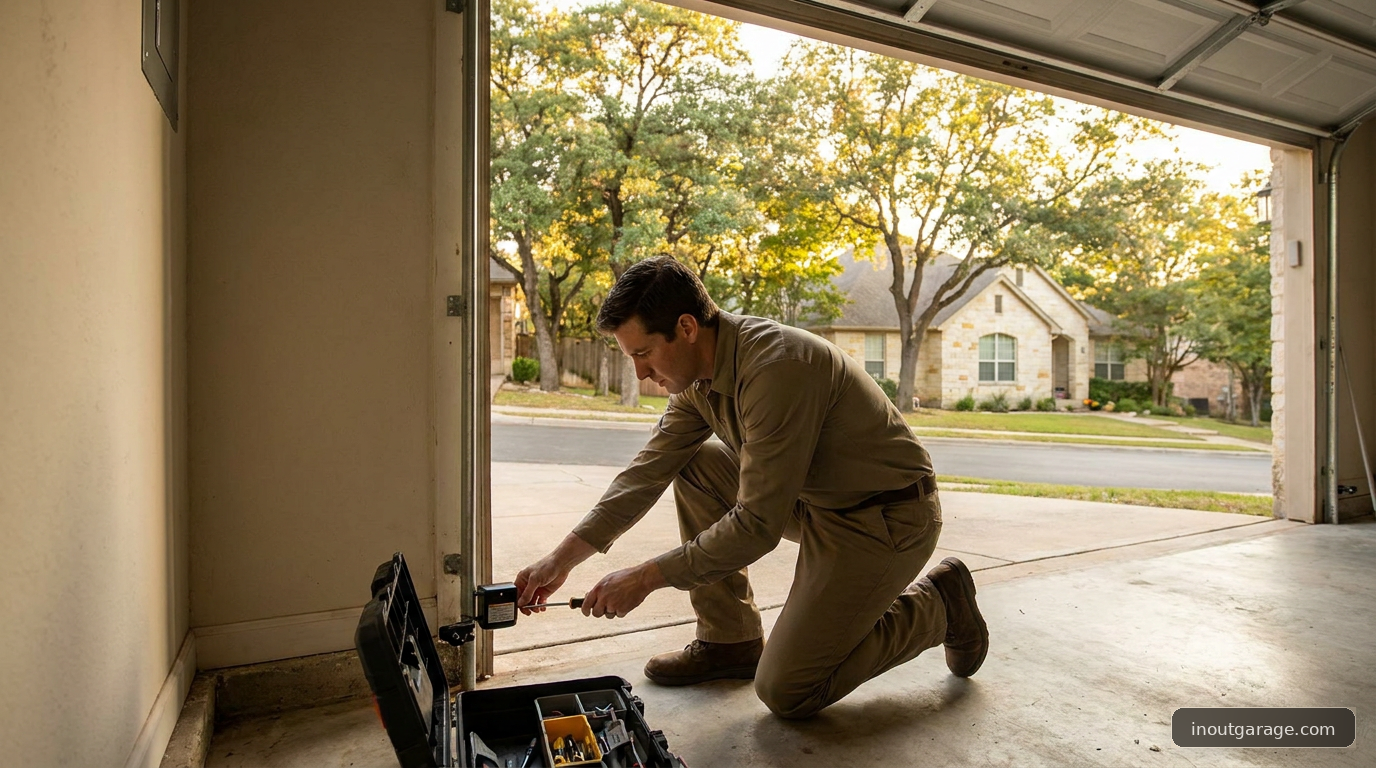
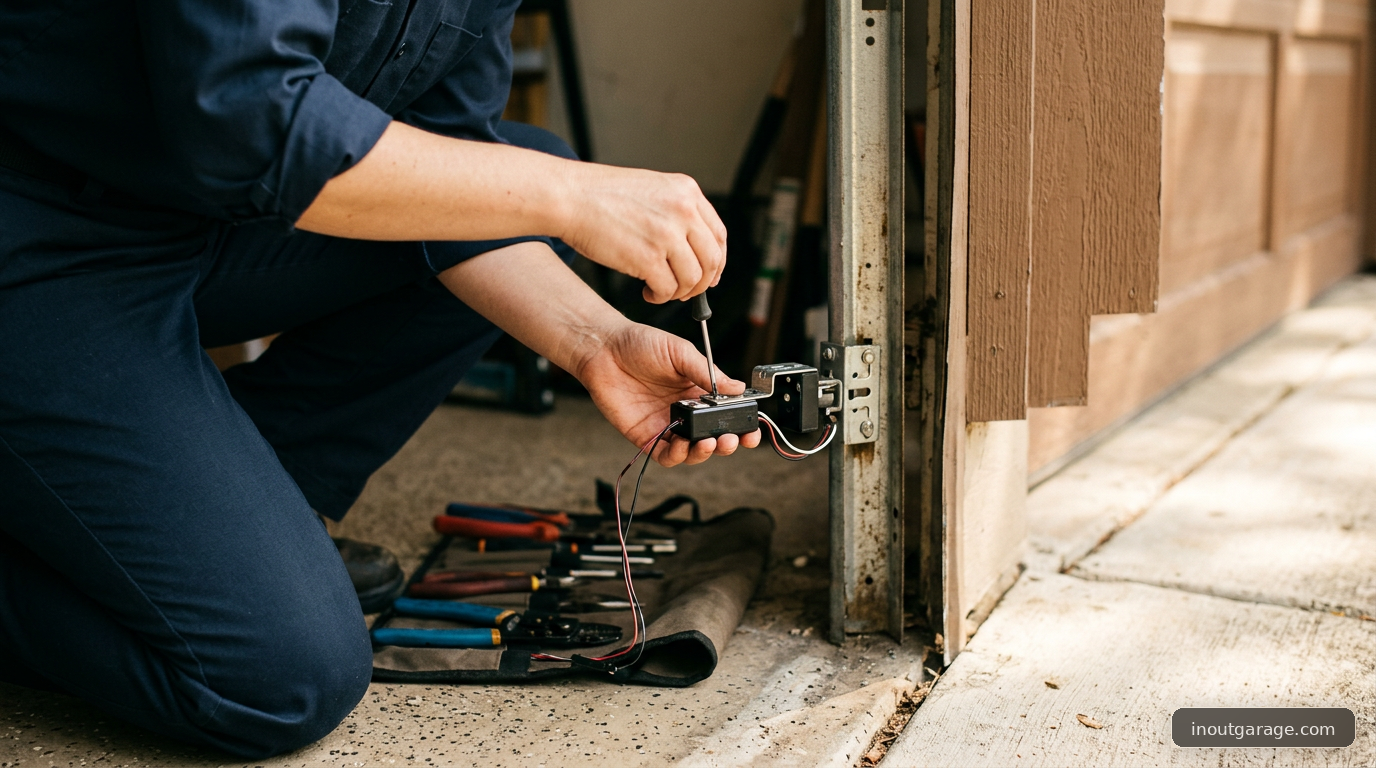
Most residential garage doors use two photoelectric sensors, often called photo-eyes, mounted a few inches off the floor on either side of the track. One sensor emits an invisible infrared beam and the other receives it. As long as that beam travels unbroken from one side to the other, the opener assumes the path is clear and allows the door to close.
The moment something blocks the beam, whether it is a pet, a box, or a person’s foot, the receiver loses the signal and tells the opener’s logic board to stop the door and reverse it immediately. This entire exchange happens in a fraction of a second, which is why a functioning sensor pair feels invisible during normal daily use.
When a sensor is misaligned, dirty, or electrically faulty, that invisible exchange breaks down. The opener either refuses to close the door at all, treating the loss of signal as a permanent obstruction, or in worse cases fails to detect a real obstruction because the system itself is unreliable.
Why Are Garage Door Sensors Required by Law?
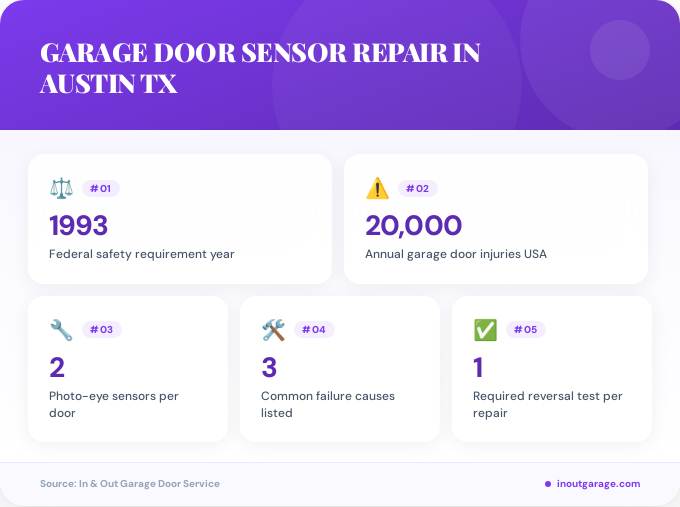
Photo-eye sensors are not an optional convenience feature. Federal rules have required automatic-reverse protection on residential garage door operators since 1993, and that standard has continued to evolve. The current federal regulation governing these entrapment protection requirements is codified under 16 CFR Part 1211, the federal safety standard for automatic residential garage door operators, which also appears in the official 2024 Code of Federal Regulations publication covering garage door operator safety standards.
Regulators have continued refining this standard, including a 2024 update process documented in the Federal Register notice on updated safety standards for automatic residential garage door operators. These rules exist because garage doors are heavy, often several hundred pounds, and moving at force against a person or pet can cause serious harm.
“The photo-eye system is the single most important safety component on a residential garage door opener. When a homeowner tells us the door won’t close, our first instinct isn’t the motor or the springs, it’s almost always the sensors or the wiring feeding them.”
Industry data cited in recent coverage of updated opener standards estimates roughly 20,000 garage-door-related injuries occur annually in the United States, with serious injury rates dropping significantly after automatic-reverse sensors became standard equipment, a trend discussed in recent industry reporting on opener safety following updated federal standards. That context matters because it reframes sensor repair as a safety repair, not a cosmetic annoyance.
What Causes Garage Door Sensors to Fail in Austin?
Austin’s climate and terrain create a specific set of stress factors for photo-eye sensors that homeowners in milder climates rarely deal with. Several patterns show up again and again on local service calls.
- Misalignment from vibration or impact: A bumped bracket, a car tapping the track, or normal settling over time can shift one sensor just enough to break the beam.
- Dust, pollen, and construction debris: Austin’s cedar pollen season, ongoing residential construction in growing neighborhoods, and dry summer dust can coat the lenses and block the signal.
- Low-angle sunlight interference: Garages facing east or west can experience sensor confusion during sunrise or sunset when direct light hits the receiver.
- Damaged or chewed wiring: Staples, rodents, corrosion, and brittle insulation near the garage floor can cause intermittent signal loss that looks like a sensor failure but is actually a wiring issue.
- Moisture and flooding: Heavy spring storms and flash flooding events common to Central Texas can corrode low-mounted sensor connections over time.
These same seasonal and environmental factors also affect broader opener performance, which is covered in more depth in our guide to what drives garage door opener repair costs in 2026.
What Are the Warning Signs of a Failing Sensor?
Most sensor problems announce themselves clearly if you know what to look for. The opener’s light often blinks a specific number of times to indicate a sensor fault, though the exact pattern varies by brand.
| Symptom | Likely Cause |
|---|---|
| Door closes partway then reverses | Misaligned or obstructed sensor |
| Door won’t close at all, light blinks | Broken beam, dirty lens, or failed sensor |
| Door closes fine sometimes, fails randomly | Loose wiring or intermittent connection |
| Sensor light is off or unsteady | Power issue, corrosion, or failed unit |
If you notice any of these symptoms, it is worth checking our broader resource on garage door repair service in Austin to understand how sensor issues fit into the larger troubleshooting picture.
What Determines the Cost of Sensor Repair?
Pricing for garage door sensor repair in Austin TX varies widely depending on what is actually wrong, how accessible the wiring is, and which brand of opener you own. A simple cleaning and realignment job is a very different scope of work than tracing damaged wiring through a finished garage wall or replacing a matched sensor pair on an older opener that no longer has an exact factory match.
Typical driver: Dust, minor bumps, loose mounts
Typical driver: Rodent damage, corrosion, staples
Typical driver: Cracked housing, dead unit, old age
Typical driver: Unclear root cause, intermittent faults
Rather than quoting a single number, it is more accurate to say that pricing varies based on your specific project, the age and brand of your opener, how the wiring was originally routed, and whether the issue is purely mechanical or involves electrical troubleshooting. A technician who gives you a number over the phone without seeing the setup is guessing. The most reliable way to know what your repair will actually cost is to request a written, itemized quote after an in-person inspection, which our team provides through our contact page.
Cost guides covering this topic, including figures referenced by Modernize’s national garage door repair cost breakdown and Easy Garage Door Repair’s dedicated sensor repair cost analysis, show that sensor work sits on the lower end of garage door repairs nationally, but local labor rates, access difficulty, and opener brand still shift the final number meaningfully.
Should You Try DIY Sensor Troubleshooting First?
There is a reasonable amount you can check yourself before calling anyone. Wipe both sensor lenses with a soft, dry cloth, confirm both units are pointed directly at each other, and check that nothing is resting in the beam path like a broom, a hose, or a stray toy.
Look at the indicator lights on both sensors. Most brands show a solid light on both units when properly aligned, and a blinking or dim light on one side usually points to either a power issue or an alignment problem. If a visual inspection and basic cleaning do not resolve it, the next step is checking the wiring, and that is where DIY often becomes risky.
Wiring work near a garage door opener’s logic board involves low-voltage circuits, but misdiagnosis can mean you spend money replacing a sensor that was never actually broken. Our guide on common garage door repair mistakes that can damage your door covers similar homeowner pitfalls worth understanding before attempting repairs yourself.
What Should You Ask Before Hiring a Repair Technician?
Not every garage door technician treats sensor repair with the same rigor. A thorough repair should always end with a physical obstruction test, meaning the technician places an object in the beam path and confirms the door reverses, not just a visual check that the lights are on.
- Does the quote separate diagnosis, parts, labor, and any trip charge?
- Will the technician perform a physical reversal test before leaving?
- Are the replacement sensors compatible with your specific opener brand and model?
- Is there a warranty on parts and labor for the sensor repair?
- If the issue turns out to be wiring or the logic board instead of the sensor itself, is that covered under the same visit?
If your garage door is older or you are weighing repair against full replacement, it helps to review our breakdown of garage door opener replacement costs in Austin TX before committing to a repeated cycle of sensor repairs on an aging unit. And if your sensor failure happens outside normal business hours and leaves your door stuck open, our 24/7 emergency garage door repair service in Austin is built for exactly that scenario.
People Also Ask
Why does my garage door open but not close?
This is almost always a sensor problem because the opener’s logic treats a broken photo-eye beam as a permanent obstruction. Check for misalignment, dirty lenses, or anything blocking the beam path between the two sensors.
Can I bypass garage door sensors temporarily?
Bypassing the sensors removes a federally mandated safety protection and is not recommended under any circumstance. If you need the door closed immediately, most openers allow manual closing by holding the wall button while watching the door the entire time.
How do I know if it’s the sensor or the wiring?
If the indicator light on one sensor flickers, goes dark intermittently, or responds to the wire being gently moved, the wiring is the likely culprit rather than the sensor unit itself. A technician can confirm this with a multimeter test in minutes.
Do garage door sensors need to match in brand?
Sensors generally need to be a matched, compatible pair designed to work with your specific opener’s logic board. Mixing incompatible brands can cause false readings even when both units appear to function individually.
Frequently Asked Questions
What is the most common cause of garage door sensor failure in Austin?+
Misalignment and dirty lenses are the two most common causes, often made worse by Austin’s seasonal dust, pollen, and occasional heavy storms. A bumped bracket or shifted track can throw off the beam alignment even when the sensor itself is undamaged.
How long does a garage door sensor repair usually take?+
A straightforward cleaning and realignment can often be completed in under an hour. Wiring repairs or full sensor replacements may take longer depending on access to the wiring and the age of the opener system.
Is it safe to keep using a garage door with a sensor fault?+
No, a malfunctioning sensor compromises the federally required automatic-reverse safety feature designed to prevent injuries to people, pets, and property. It should be addressed promptly rather than worked around with manual overrides.
Can sunlight really interfere with garage door sensors?+
Yes, direct low-angle sunlight hitting the receiver sensor can overwhelm its ability to detect the infrared beam, especially during sunrise or sunset in garages facing east or west. A small shade or visor over the sensor often resolves this.
Should I replace both sensors or just the broken one?+
Many technicians recommend replacing both sensors as a matched pair, particularly on older systems, since the remaining sensor is likely nearing the end of its service life too. This also ensures full compatibility and calibration between both units.
Does homeowners insurance cover garage door sensor repair?+
Standard homeowners insurance typically does not cover routine wear-and-tear repairs like sensor failure unless the damage resulted from a covered event such as a storm or fire. It is worth checking your specific policy language if the damage was sudden and accidental.
Garage door sensors are a small part of a much bigger system, and understanding how they work puts you in a stronger position whether you are scheduling a repair, planning a new garage door installation in Austin, or simply trying to figure out why your door won’t close tonight. For homeowners weighing repair against a full system upgrade, our team at In and Out Garage Doors also handles everything from expert garage door repair and installation services to smart opener upgrades. If you are searching for garage door repair near you in Austin or want a second opinion on a sensor diagnosis from another company, reach out for a straightforward, written inspection and quote before authorizing any work. You can also explore our deeper guide on reliable garage door repair service in Austin for more context on how these repairs fit into routine home maintenance.
Key Takeaways
- Garage door photo-eye sensors create an invisible beam that must stay unbroken for the door to close safely.
- Federal law has required automatic-reverse protection on residential openers since 1993, and the standard continues to be updated.
- Misalignment, dust, sunlight, damaged wiring, and moisture are the leading causes of sensor failure in Austin homes.
- A blinking opener light almost always signals a sensor fault, though the specific blink pattern varies by brand.
- Pricing for sensor repair depends on scope, from simple cleaning to full wiring repair or matched-pair replacement, so always request a written quote.
- Never bypass or disable safety sensors, even temporarily, since this removes a federally mandated injury-prevention feature.
- A proper repair always ends with a physical obstruction test, not just a visual confirmation that the lights are on.

