Quick Answer
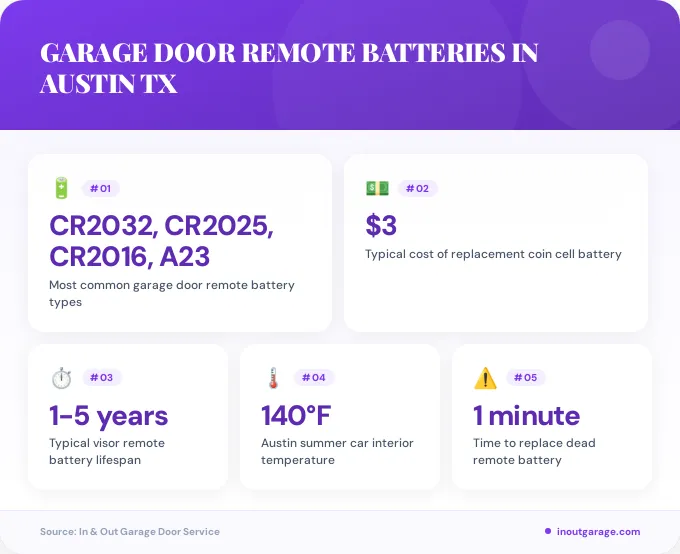
Most garage door remotes in Austin TX use a CR2032, CR2025, CR2016, or A23 12-volt battery, and the correct type depends on the specific remote model rather than the opener brand. A fresh coin-cell battery is typically available at low cost at retail, while a technician visit for a full diagnosis, replacement remote, or reprogramming costs more because you’re paying for labor and a trip charge, not the battery itself. Call for a free written quote to understand what’s included in any service offer.
Here’s a scenario that surprises most homeowners: a garage door remote that won’t open the door is almost never the opener’s fault. More often it’s a battery no bigger than a nickel. Yet every year, Austin homeowners book full service calls, sometimes paying for diagnosis and labor, when a simple battery replacement would have solved the problem in under a minute.
This guide breaks down garage door remote batteries in Austin TX: the battery types, the lifespan you should realistically expect, the compatibility traps that catch people off guard, and the red flags that separate a fair quote from an inflated one. Whether you’re standing in the battery aisle at a hardware store on South Lamar or trying to decide whether to call a technician, this is the information you need before you spend money on a fix.
What Battery Does My Garage Door Remote Actually Need?
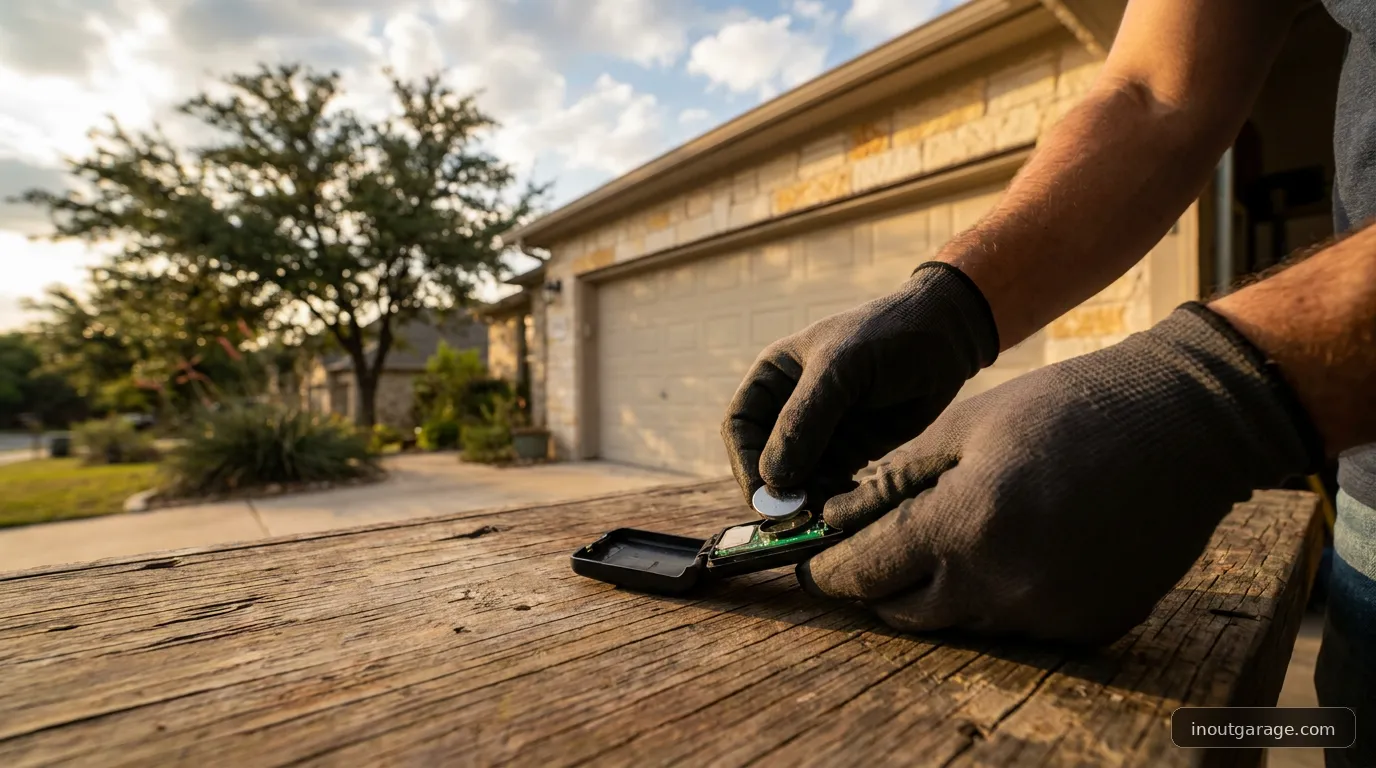
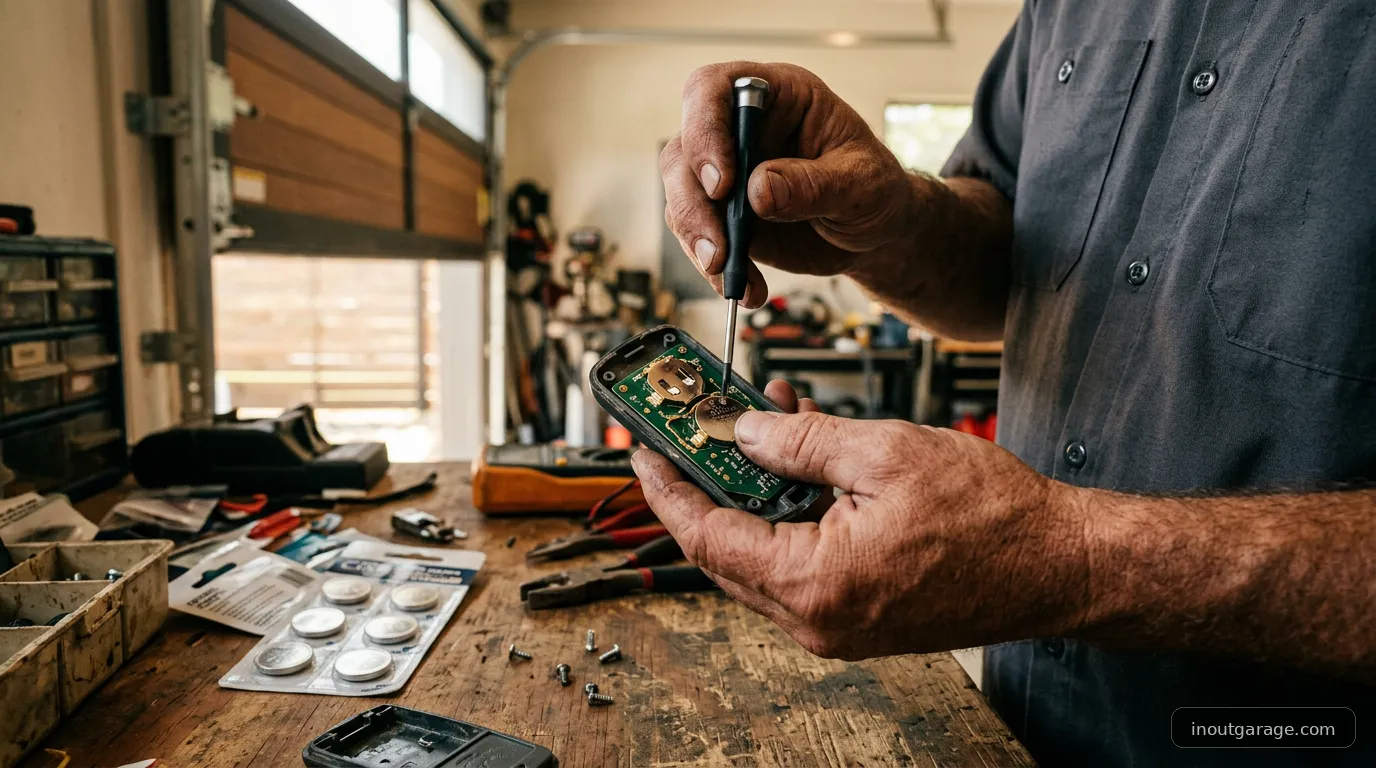
Garage door remotes are small, low-power devices, and manufacturers choose batteries based on the remote’s internal design, not the brand of your opener. That means two Chamberlain remotes bought five years apart can use completely different batteries. The four most common types in circulation today are:
- CR2032: A 3-volt lithium coin cell and the most widely used battery in modern visor remotes.
- CR2025: Same diameter as a CR2032 but noticeably thinner, used only in remotes designed for it.
- CR2016: Thinner still, and substituting it for a CR2025 or CR2032 slot can cause weak contact or a short usable life.
- A23/23A: A small 12-volt cylindrical battery found in some older remotes and wireless keypads.
Some larger remotes, external receivers, and smart-access accessories use AAA or AA batteries instead. There’s also a separate category entirely: the opener backup battery, a rechargeable unit mounted inside or attached to the motor unit on the ceiling. That’s not the same component as your handheld remote battery, and confusing the two is one of the most common mistakes homeowners make when searching for a fix.
Before buying anything, check the number printed directly on the old battery or look at the label inside the remote’s battery compartment. A detailed breakdown of battery types and symptoms is available from this garage door remote battery guide, which confirms that model number, not opener brand, determines the correct battery.
How Long Do Garage Door Remote Batteries Last?
Coin-cell batteries in a typical visor remote last anywhere from one to five years depending on usage frequency, battery quality, and how often the remote sits in a hot car. Austin summers push interior car temperatures well above 140°F, and repeated heat cycling is known to shorten lithium battery life faster than moderate climates would. If your remote lives on your sun visor or dashboard, expect a shorter lifespan than the manufacturer’s published estimate.
A23 batteries used in older remotes and keypads tend to drain faster because of their higher voltage draw, often needing replacement annually or more frequently in units used several times a day. Rechargeable opener backup batteries follow a different curve entirely: most are rated to hold a charge for two to five years before they lose the ability to maintain power during even a brief outage.
What Are the Signs the Battery Is the Problem?
Not every malfunctioning remote means a dead battery, but certain symptoms point squarely at it. Watch for these patterns before assuming you need a repair:
- Reduced operating range, where the remote only works if you’re parked right at the driveway entrance.
- The remote functions only when held unusually close to the garage door or opener unit.
- Intermittent operation, sometimes opening the door and sometimes not, with no pattern.
- You have to press the button repeatedly or unusually hard to get a response.
- The wall-mounted control button still works normally while the handheld remote does not.
- The remote’s small indicator light is dim, flickers, or doesn’t illuminate at all when pressed.
Austin-area service guidance specifically flags weak or intermittent range, paired with a fully functional wall button, as the classic signature of a battery issue rather than an opener fault. If you’re dealing with a door that won’t respond at all, even from the wall console, the problem is more likely tied to the opener’s electronics or the safety sensor system. For that scenario, our breakdown of how garage door safety sensors work and why they fail covers a different but commonly confused failure point.
What Compatibility Factors Should I Check Before Buying?
Buying the wrong battery is the single most common and most avoidable mistake. Here’s what actually determines compatibility:
| Battery Type | Common Use Case |
|---|---|
| CR2032 | Most modern visor and keychain remotes |
| CR2025 | Slimmer remote models, check before substituting |
| CR2016 | Compact remotes with tight battery compartments |
| A23/23A | Older remotes and wireless entry keypads |
| AAA/AA | Larger remotes, external receivers, smart accessories |
Do not assume every Chamberlain, LiftMaster, Genie, Craftsman, or Overhead Door remote takes the same battery. Model year, remote series, and even regional manufacturing runs can change the internal battery holder size. If you’re replacing a lost or broken remote entirely rather than just the battery, compatibility with your existing opener’s frequency and rolling code becomes the bigger question, and it’s worth reviewing our guide on how to program a remote garage door opener or step-by-step remote programming instructions before you buy a universal replacement.
The universal remote-control market itself is expanding quickly, with researchers projecting roughly 7.3% compound annual growth between 2025 and 2031, which means more cross-brand options are hitting shelves. More choice also means more chances to buy something that doesn’t quite match your opener’s rolling code system, so confirm compatibility before purchasing.
What Actually Drives the Cost of Battery and Remote Service?
The price gap between a battery and a service call confuses a lot of homeowners, and for good reason. A coin-cell battery is inexpensive at any retail store, yet a technician visit framed as “opener repair” can be dramatically higher. Here’s what actually drives that difference:
- Diagnosis time: A technician confirming whether the issue is the battery, the remote’s internal circuit, the receiver, or the sensors takes time regardless of the final fix.
- Trip charges: Minimum service fees apply whether the visit resolves a simple battery issue or a full opener repair.
- Reprogramming: Syncing a new remote or keypad to your specific opener’s rolling code takes additional steps beyond simply inserting a battery.
- Part sourcing: If your remote is old or discontinued, finding a compatible replacement may require special ordering.
- Urgency: Same-day or after-hours requests typically carry a premium over scheduled daytime visits.
Several factors affect the total investment required, including labor, diagnostics, travel time, and whether parts need to be ordered. The specific breakdown varies by job, so it’s important to request a free written quote that itemizes what you’re paying for before any work begins. This ensures you understand whether the charge covers a battery replacement, a full replacement remote, or a complete service call with comprehensive diagnostics. Industry guidance confirms that these are three distinct service categories with different price points, and vague quotes often bundle them without transparency.
Before agreeing to any quote, ask directly whether the number you’re given covers a battery, a replacement remote, or a full service call with labor. These are three different products with three different price points, and a vague quote often means they’ve been bundled without your knowledge.
Tools required: Small screwdriver, often none
Best for: Confirmed weak or dim remote signal
Tools required: None, usually self-paired
Best for: Lost, cracked, or discontinued remotes
Tools required: Diagnostic equipment
Best for: Wall button also failing or opener motor issues
What Red Flags Should Make You Stop and Ask Questions?
A battery issue is one of the cheapest, simplest fixes in garage door service, so pricing or advice that doesn’t match that reality deserves a second look. Watch for:
- A quote that jumps straight to opener replacement before anyone has confirmed the wall button and battery have been tested.
- No mention of the battery type when a technician recommends a new remote, which suggests they haven’t actually opened the compartment to check.
- Pressure to buy a whole new opener system when the symptom described is simply reduced range, a classic battery sign.
- Vague pricing that doesn’t distinguish between a battery, a remote, and a labor charge.
- Unwillingness to provide a written quote before any work begins.
If your garage door isn’t opening or closing at all, and the issue isn’t resolved by a fresh battery, the cause may be unrelated to the remote entirely. Troubleshooting guidance on non-responsive garage doors points out that sensor misalignment, track obstructions, and opener logic board failures can all mimic a dead remote, which is exactly why ruling out the battery first saves you from paying for the wrong diagnosis.
What Questions Should You Ask Before Buying or Booking Service?
Whether you’re buying a battery, a replacement remote, or booking a technician, these questions protect you from overpaying or buying the wrong part:
- What is the exact battery number printed on the old battery or inside the compartment?
- Is this remote original to the opener, or has it already been replaced once?
- Does the wall-mounted control still operate the door normally?
- Is the quote for a battery only, a new remote, or a full labor visit?
- Will reprogramming be included, or is that billed separately?
- Is my opener’s rolling code system compatible with a universal remote, or do I need an OEM part?
- If my opener’s backup battery is the issue instead of the remote, is that priced differently?
If the answers suggest you need more than a battery, whether that’s a failing opener motor, a damaged circuit board, or an aging system near the end of its service life, it may be time to look at broader options like garage door opener replacement or smart garage door opener installation, which also eliminates many coin-cell battery headaches by switching to app-based access. For homeowners whose entire door and opener system is aging, our garage door installation services in Austin and broader garage door installation resources outline what a full upgrade involves. If the issue is isolated and repairable, our garage door repair service in Austin and general garage door repair page both cover diagnostic visits without unnecessary upselling. Local providers like Bramwell Garage Doors’ Austin service page similarly recommend confirming the simple causes before approving larger repair work.
People Also Ask
Why is my garage door remote not working even with a new battery?
If a fresh battery doesn’t fix it, the problem may be the remote’s internal circuit, a receiver issue in the opener unit, or a signal conflict from nearby electronics. At that point reprogramming or testing with a second remote helps isolate the cause.
Can I use a CR2025 battery instead of a CR2032?
Only if the remote’s manual or label specifies it as acceptable, since the two batteries differ in thickness even though their diameter is similar. Using the wrong one can cause poor contact or a much shorter lifespan.
How often should I replace my garage door remote battery in Austin?
Most coin-cell batteries last one to five years, but Austin’s hot summers can shorten that if the remote sits in a hot car regularly. If range starts dropping noticeably, replace the battery rather than waiting for complete failure.
Is the opener’s backup battery the same as the remote’s battery?
No, these are entirely separate components. The remote’s battery is a small coin cell or cylindrical battery inside the handheld device, while the opener’s backup battery is a rechargeable unit mounted inside or near the motor unit on the ceiling.
Frequently Asked Questions
What battery type does my garage door remote use?+
Most modern remotes use a CR2032, CR2025, CR2016, or A23 12-volt battery, but the correct type depends on your specific remote model rather than the opener brand. Always check the number printed on the old battery before buying a replacement.
How do I know if it’s the battery and not the opener itself?+
If the wall-mounted control button still opens and closes the door normally while the handheld remote doesn’t respond or has reduced range, the battery is the most likely cause. If the wall button also fails, the problem is elsewhere in the system.
Why is a technician visit so much more expensive than the battery itself?+
A coin-cell battery costs very little on its own, but a technician visit includes diagnosis time, a minimum trip charge, and often reprogramming labor if a new remote is involved. Always ask whether a quote covers the battery, a new remote, or a full labor visit before agreeing to anything.
Does every brand of garage door opener use the same remote battery?+
No. Chamberlain, LiftMaster, Genie, Craftsman, and Overhead Door remotes can all use different battery types depending on the specific remote model and production year. Never assume compatibility based on brand alone.
Can I just buy a universal remote instead of matching the battery type?+
Universal remotes can work, but you still need to confirm they’re compatible with your opener’s rolling code system and frequency before buying. The universal remote market is growing quickly, but not every unit pairs with every opener model.
What’s the difference between the remote battery and the opener’s backup battery?+
The remote battery powers the small handheld device you carry, while the opener’s backup battery is a separate rechargeable unit mounted on the motor that keeps the door working during a power outage. They fail independently and require different replacement parts.
Should I replace the remote or just the battery?+
If the remote shows symptoms like reduced range or a dim indicator light, try a battery replacement first since it’s the cheaper and faster fix. Only replace the entire remote if a fresh battery doesn’t resolve the issue or the remote is physically damaged.
Related: Why Is My Garage Door Not Closing in Austin TX? A Homeowner’s Buyer’s Guide to Diagnosis and Repair
Garage door remote batteries are one of the easiest things to diagnose and fix yourself, but compatibility mistakes and vague service quotes can turn a simple fix into an unnecessary expense. Confirm the exact battery number, test the wall control, and ask pointed questions before agreeing to any repair. If you’ve ruled out the battery and something still isn’t working right, our team at In & Out Garage Door Service can provide a clear, written diagnosis for your Austin home, whether that means a quick remote fix or a broader look at your opener system. Contact us for a free written quote, or learn more about our team on our about page.
Key Takeaways
- Most remotes use a CR2032, CR2025, CR2016, or A23 battery, and the correct type depends on the remote model, not the opener brand.
- Reduced range, dim indicator lights, and a working wall button alongside a failing remote all point to a battery issue.
- Austin’s summer heat can shorten coin-cell battery life faster than moderate climates, especially for remotes left in hot cars.
- The opener’s rechargeable backup battery is a separate component from the remote’s battery and fails on its own schedule.
- Always ask whether a quote covers a battery, a replacement remote, or a full labor visit before approving any work.
- Universal remotes are a growing market option, but confirm rolling code compatibility with your opener before buying.
- If a fresh battery doesn’t solve the issue, the cause is likely elsewhere in the system and worth a professional diagnosis.